

Beyond
the Magic
Where AI works wonders, leadership works people

AI used to be an academic discipline. It lived inside research papers and conferences and the occasional dinner conversation between people who worked in tech. Then, on November 30 2022, something changed. ChatGPT launched.
It wasn’t supposed to be a global event. It was meant to be a low-key research experiment, the first one released to the public without restrictions – no waitlist, no approvals, no NDA. Just open. And that was a very significant date. I think of it like when Nixon separated the dollar from the gold standard.
ChatGPT hit five million users in a couple of weeks. But no one was ready. None of the questions had been answered. It was reckless, probably dangerous, but also extraordinary. Within months, other systems like Midjourney were open-sourcing their tools. Amazon dropped billions on Anthropic, Microsoft doubled down on OpenAI.
Then there was that Google demo that went wrong – a small factual mistake about the James Webb telescope – and the share price fell by billions. That’s how brittle our confidence is in something that feels like magic but isn’t.
That moment showed what we still don’t understand: that we don’t understand. We see the output and we think we’re seeing understanding. But it’s a trick of language. People ask AI how it works and it says “magic”, and it’s half right. It replies that way because it recognises that magic is the closest metaphor.
A hundred years ago, cars felt like magic. Trains in the 1860s were magic. In the 1920s, cinema was magic. Every advanced technology feels like magic until we have a century of assumed knowledge around it. We understand cars now. We know they’re dangerous. We have regulations, driving tests, rules. You don’t give a 16-year-old a V8 engine. But with AI, we have no equivalent understanding. We don’t know the danger level, the licensing or even what the engine is.
“AI doesn’t make us better listeners… And you can’t outsource presence.”
Tea Uglow
That confusion carries straight into the workplace. Surveys show that people inside organisations say AI is making them stressed, less productive and unsure of expectations. Freelancers, meanwhile, report a 100% increase in productivity. The difference isn’t the technology – it’s incentives. Inside an organisation, there’s no benefit in showing that you can do your work in half the time. You’ll just get given more work, or fewer colleagues. Outside, efficiency is rewarded. Freelancers are optimised for speed. So this isn’t a technical issue – it’s a management one.
Leaders have to bring their staff with them. That means building trust and making the incentives clear. Otherwise, people won’t share what they’ve learned or how they use these tools. They’ll just quietly do the fast work at home and re-present it slowly in the system. Because our entire industrial model still charges for time. And time is no longer a fair measure of value.
The first human skill that matters is communication and presence. Leaders need to be present in people’s lives – to be there, to listen, to communicate trust. AI doesn’t make us better listeners. It doesn’t make us more human. It can score higher on empathy tests, yes, because it’s better at decoding what we say. But it doesn’t feel it. It doesn’t mean it. Empathy is often overstated. People like to believe they have it. But empathy is often just projection. Communication, on the other hand, is real. You can outsource empathy, maybe, but you can’t outsource communication. You can’t outsource presence.
The second skill is domain expertise. Knowledge still matters, especially when the machine sounds convincing. The James Webb incident is a perfect parable: without an astronomer in the room, no one noticed the AI was confidently wrong. The same will be true in every field. You can automate an accountant’s calculations, but not their judgement. You can generate 100 pieces of copy, but only a human will choose the one that resonates. In a world of abundance, discernment becomes the mark of genius.
Creativity itself will not die. Culture is safe. No one tunes in to watch a robot play chess, even if the robot wins. We watch Magnus Carlsen because he’s human – fallible, brilliant, unpredictable. We want to see our reflection in the act of creation.
AI is a constant wave. Every few months a new swell rolls in, and you’re just trying to stay on the board. Unlike the internet, which had years to settle, AI doesn’t give you a calm stretch to catch your breath. Leaders need to stay flexible, keep paddling and ride the wave as it comes. It’s hard to lead when the future won’t sit still, but that’s the work.
Flexibility, perseverance and a willingness to move – those are the leadership traits that will matter. The ones who succeed will be the ones who can keep communicating through the uncertainty, who stay steady while the magic dazzles everyone else. Because AI really does feel like magic. It looks like magic. It sounds like magic. But leadership is not. Leadership is human. It’s messy and slow and uncertain and emotional. It’s the opposite of the smooth surface the technology presents. And that’s why it matters. AI can make the work, but only humans can make it mean something.
Tea Uglow is a Peabody winning creative and strategic business consultant and a long-standing industry leader in emerging technology. In 2023, she left Google after 17 years as a founder member of Google’s Creative Lab. She writes about AI, creativity, society and systems at her Substack, Enough About That.
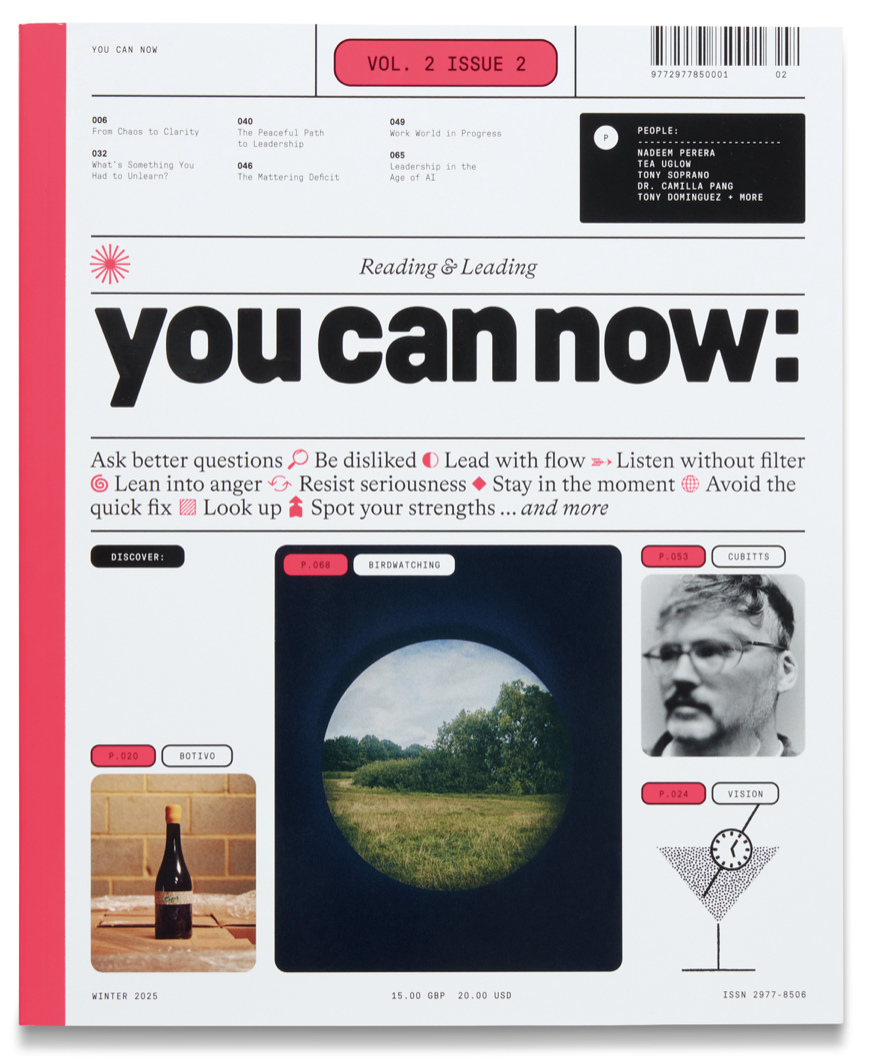
Tea’s essay was originally published in the Winter 2025 issue of You Can Now Magazine.