
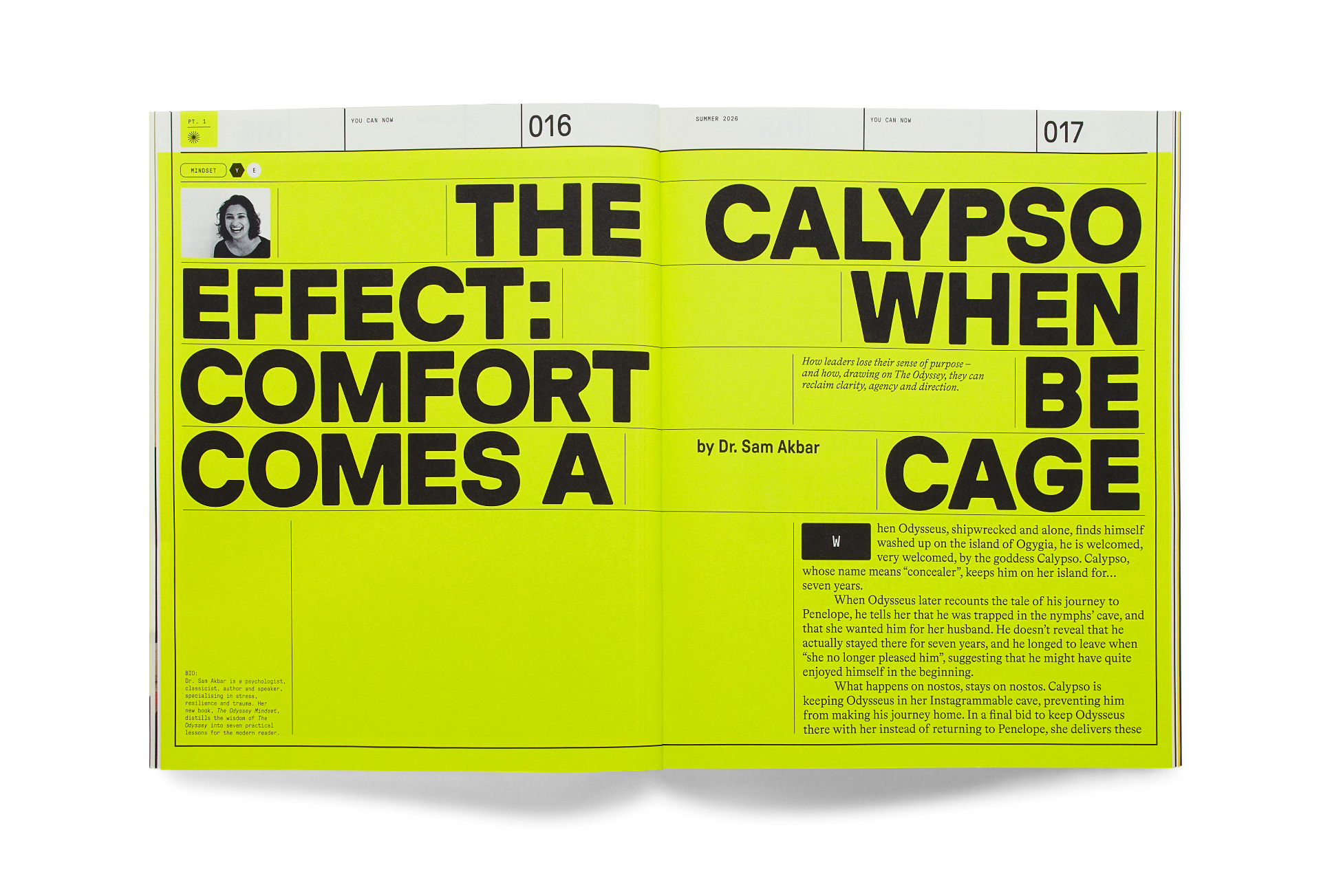
THE CALYPSO EFFECT:
HOW COMFORT
BECOMES A CAGE

How leaders lose their sense of purpose – and how, drawing on The Odyssey, they can reclaim clarity, agency and direction.

When Odysseus, shipwrecked and alone, finds himself washed up on the island of Ogygia, he is welcomed, very welcomed, by the goddess Calypso. Calypso, whose name means “concealer”, keeps him on her island for… seven years.
When Odysseus later recounts the tale of his journey to Penelope, he tells her that he was trapped in the nymphs’ cave, and that she wanted him for her husband. He doesn’t reveal that he actually stayed there for seven years, and he longed to leave when “she no longer pleased him”, suggesting that he might have quite enjoyed himself in the beginning.
What happens on nostos, stays on nostos. Calypso is keeping Odysseus in her Instagrammable cave, preventing him from making his journey home. In a final bid to keep Odysseus there with her instead of returning to Penelope, she delivers these words, perhaps with an exasperated sigh: “And anyway, I know my body is better than hers. I am taller too. Mortals can never rival the immortals in beauty.”
You have to give it to her, she knows her worth. And she’s mightily annoyed with the gods for making her give up Odysseus. She lets fly at Hermes that the gods bear a grudge whenever any goddess takes a man to sleep with. She’s calling out the double standards. Not only does she offer Odysseus her eternal beauty but makes the most significant offer a god can to a mortal: she will make him immortal and ageless (no good being immortal if you continue to age, morphing into a desiccated husk who can never die). He can live without pain or suffering with an ageless beauty in a desirable property. In modern terms she’s offering him the ultimate lifestyle upgrade: no aging, no death, no struggle, just endless gratification.
“This is what our achievement and consumer-driven culture promises: the right job will fulfil you, the perfect relationship will complete you, the ideal body will make you confident, the correct productivity app will organise your life.”
This is essentially what our achievement- and consumer-driven culture promises: the right job will fulfil you, the perfect relationship will complete you, the ideal body will make you confident, the correct productivity app will organise your life, the optimal wellness routine will eliminate suffering. We are constantly, and relentlessly, being offered modern versions of Calypso’s bargain: comfort and pleasure in exchange for our authentic selves.
And just as it did for Odysseus, it happens gradually and subtly, until the years pass and we suddenly find ourselves irrevocably detached from who we really are and what is really important to us. We have given up fighting for the more difficult things that might bring more long-term happiness: seeing through the ups and downs of a relationship, working slowly and steadily to improve your health, accepting the imperfection of being a human being.
Odysseus, however, is miserable in paradise with an ageless goddess. He wants to go home to his shorter, less beautiful wife. He chooses the uncertainty of a dangerous journey and eventual death over the comfortable security of eternal life on a paradise island. Despite having what looks like the perfect life, he is utterly disconnected from his true self.
It represents what researchers call the “hedonic treadmill” – the way external improvements in our circumstances often fail to create lasting satisfaction if they don’t align with our core values and relationships. Staying with Calypso means giving up on his journey home, his nostos. That means giving up on himself. It means forgetting home. It means a spiritual and emotional death.
When The Odyssey shows you Odysseus languishing in an ostensibly perfect life, it is asking you an important question: what is it that really matters to you? Is it a life without pain, and possibly without meaning, or is it one with true connection and love even if it comes with loss? Would you choose a life of endless ease or would you accept that deep love with another human being comes with unavoidable grief? Is the prospect of loss actually what makes it so very precious?
The Calypso Effect happens in our lives when we adapt so completely to constraining circumstances that we lose the motivation to seek something better. The corporate employee who hates their job but fears the uncertainty of change, the person in an unfulfilling relationship who dreads being alone, the artist who abandons creative risks for reliable income – all experience versions of this gilded cage.
Breaking free from the Calypso Effect requires reconnecting with deeper values beyond immediate comfort. Only when Odysseus remained clear about what truly mattered to him – home, family, identity – could he reject the temptation of remaining comfortably numb.
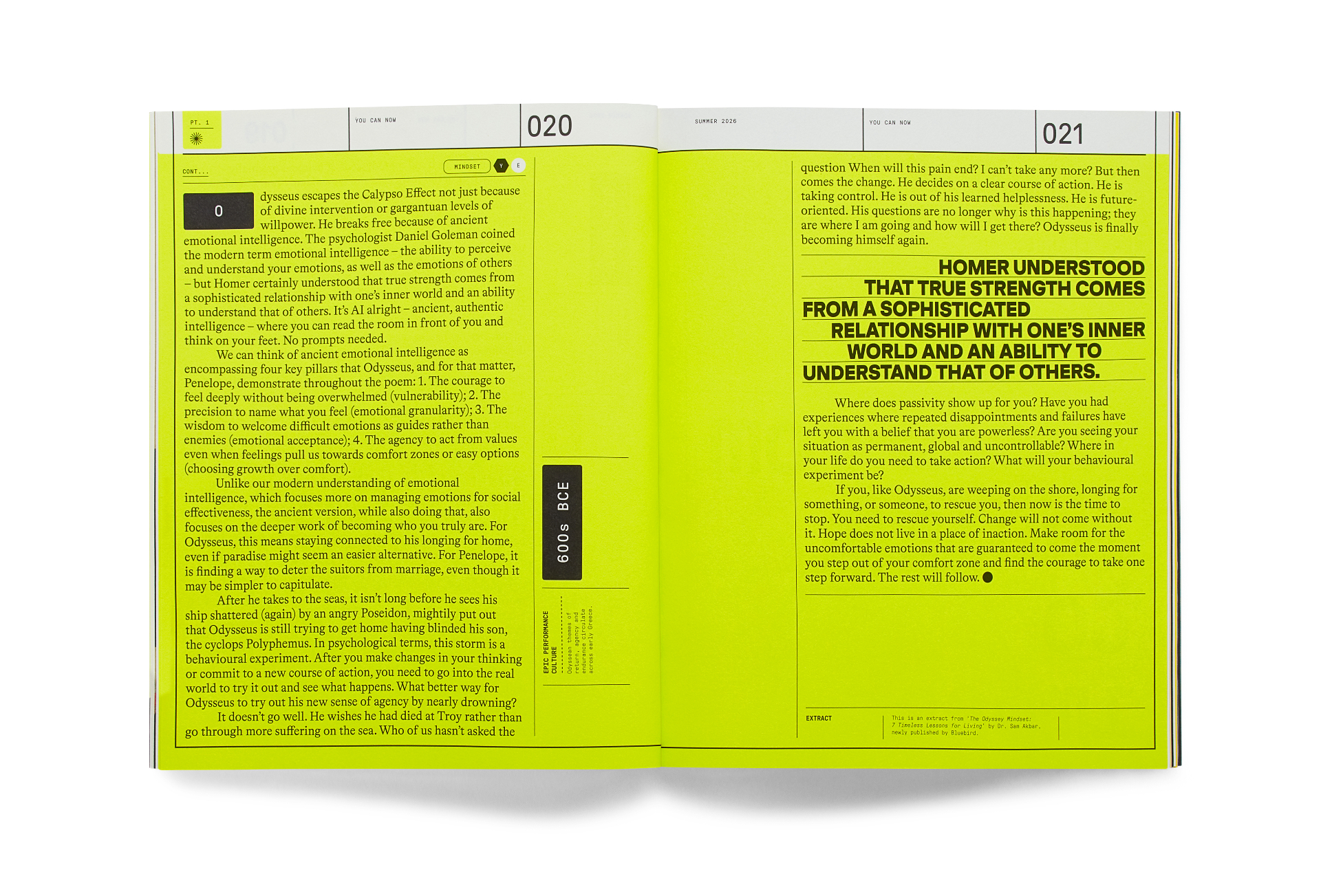
Odysseus escapes the Calypso Effect not just because of divine intervention or gargantuan levels of willpower. He breaks free because of ancient emotional intelligence. The psychologist Daniel Goleman coined the modern term emotional intelligence – the ability to perceive and understand your emotions, as well as the emotions of others – but Homer certainly understood that true strength comes from a sophisticated relationship with one’s inner world and an ability to understand that of others. It’s AI alright – ancient, authentic intelligence – where you can read the room in front of you and think on your feet. No prompts needed.
“Homer understood that true strength comes from a sophisticated relationship with one’s inner world and an ability to understand that of others.”
We can think of ancient emotional intelligence as encompassing four key pillars that Odysseus, and for that matter, Penelope, demonstrate throughout the poem:
- 01Vulnerability
The courage to feel deeply without being overwhelmed.
- 02Emotional granularity
The precision to name what you feel.
- 03Emotional acceptance
The wisdom to welcome difficult emotions as guides rather than enemies.
- 04Choosing growth over comfort
The agency to act from values even when feelings pull us towards comfort zones or easy options.
Unlike our modern understanding of emotional intelligence, which focuses more on managing emotions for social effectiveness, the ancient version, while also doing that, also focuses on the deeper work of becoming who you truly are. For Odysseus, this means staying connected to his longing for home, even if paradise might seem an easier alternative. For Penelope, it is finding a way to deter the suitors from marriage, even though it may be simpler to capitulate.
After he takes to the seas, it isn’t long before he sees his ship shattered (again) by an angry Poseidon, mightily put out that Odysseus is still trying to get home having blinded his son, the cyclops Polyphemus. In psychological terms, this storm is a behavioural experiment. After you make changes in your thinking or commit to a new course of action, you need to go into the real world to try it out and see what happens. What better way for Odysseus to try out his new sense of agency by nearly drowning?
It doesn’t go well. He wishes he had died at Troy rather than go through more suffering on the sea. Who of us hasn’t asked the question When will this pain end? I can’t take any more? But then comes the change. He decides on a clear course of action. He is taking control. He is out of his learned helplessness. He is future-oriented. His questions are no longer why is this happening; they are where I am going and how will I get there? Odysseus is finally becoming himself again.
Where does passivity show up for you? Have you had experiences where repeated disappointments and failures have left you with a belief that you are powerless? Are you seeing your situation as permanent, global and uncontrollable? Where in your life do you need to take action? What will your behavioural experiment be?
If you, like Odysseus, are weeping on the shore, longing for something, or someone, to rescue you, then now is the time to stop. You need to rescue yourself. Change will not come without it. Hope does not live in a place of inaction. Make room for the uncomfortable emotions that are guaranteed to come the moment you step out of your comfort zone and find the courage to take one step forward. The rest will follow
This is an extract from ‘The Odyssey Mindset: 7 Timeless Lessons for Living’ by Dr. Sam Akbar, newly published by Bluebird.
Bio: Dr. Sam Akbar is a psychologist, classicist, author and speaker, specialising in stress, resilience and trauma. Her new book, The Odyssey Mindset, distills the wisdom of The Odyssey into seven practical lessons for the modern reader.
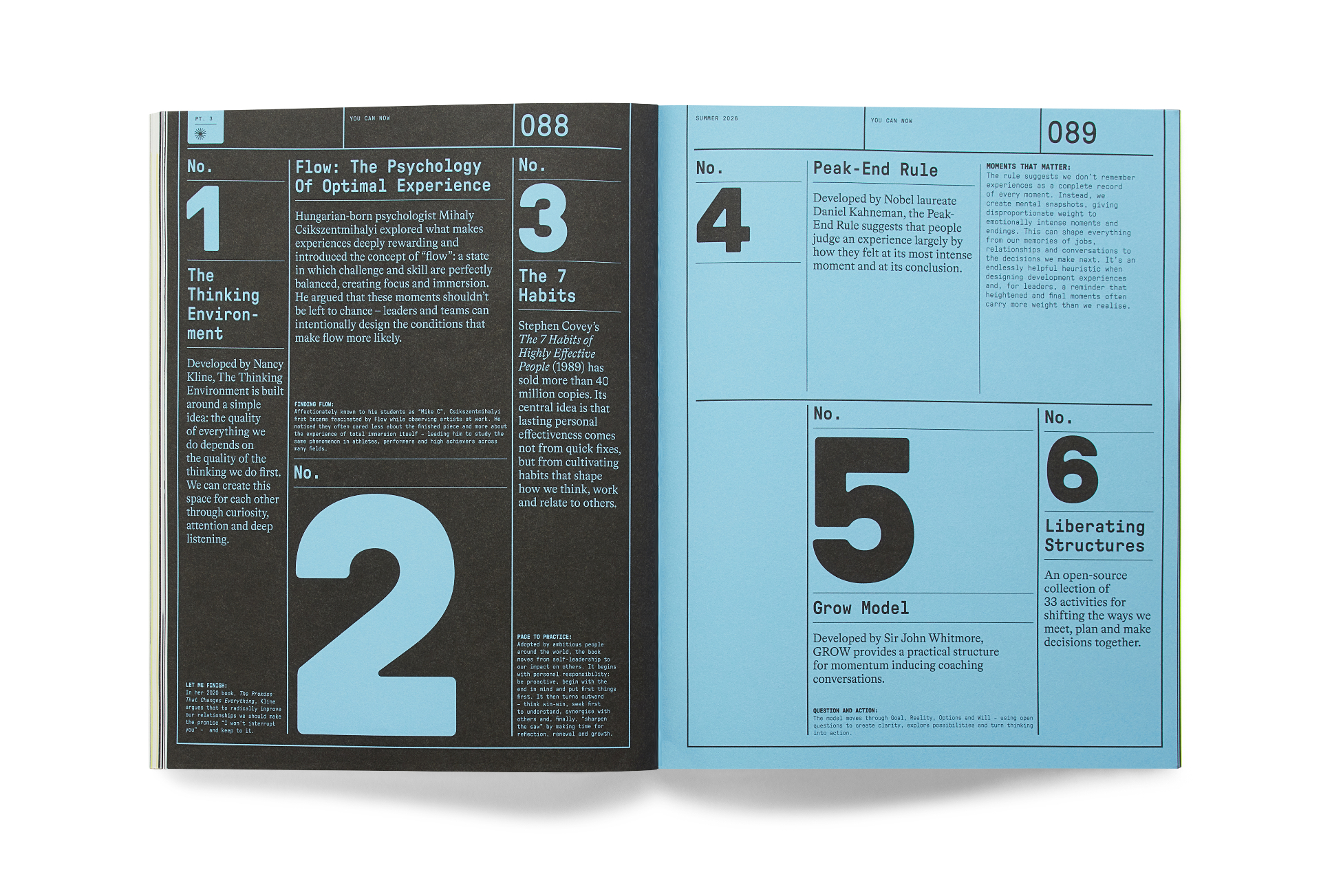
This feature originally appeared in the pages of the Summer 2026 issue of You Can Now Magazine.